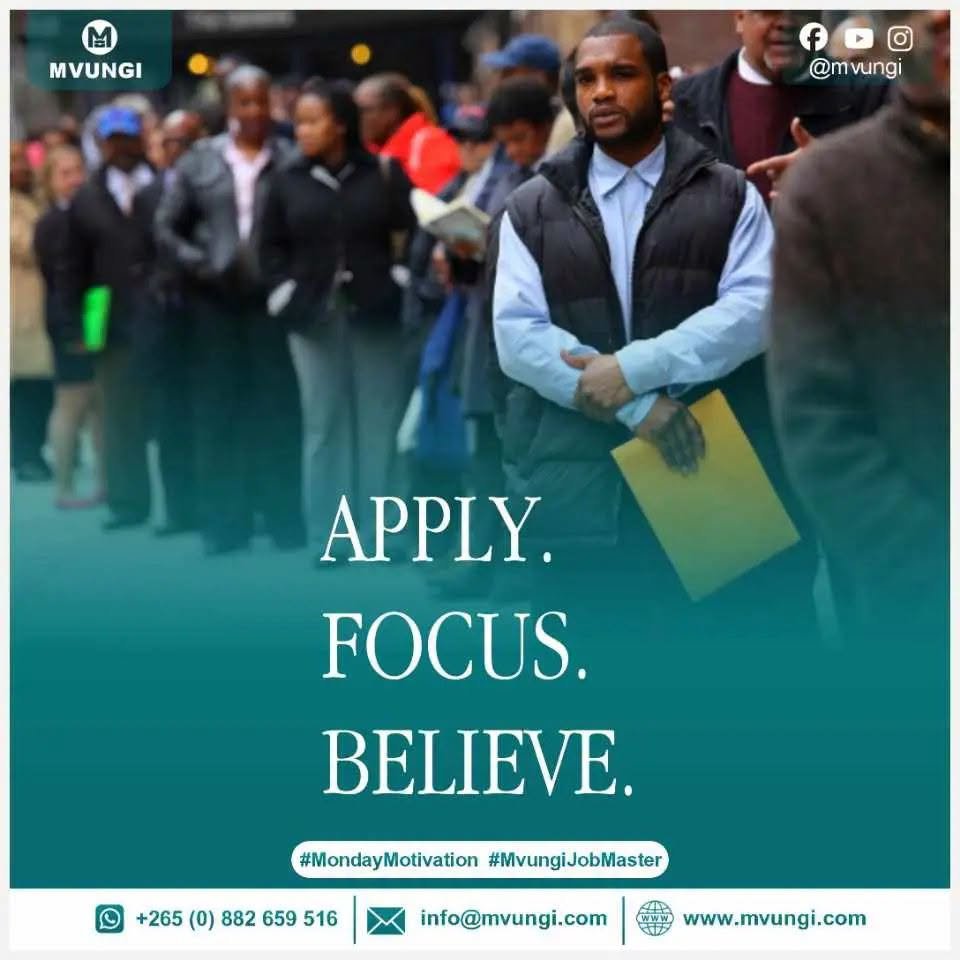
You went to school.
You attended classes, completed assignments, sat examinations and worked towards obtaining your qualification. Perhaps you earned your Malawi School Certificate of Education (MSCE), a diploma, a bachelor's degree or a professional certificate.
You expected that after all those years of studying, finding employment would become the next step.
But months have passed. Perhaps even years.
You search for job vacancies in Malawi. You check recruitment announcements on social media. You visit company websites. You prepare applications and send your CV to employers.
Yet the results are not what you expected.
You may have the qualifications required for a position, but you are still not receiving interview invitations. You may even find yourself competing for opportunities that attract hundreds of other applicants.
If this sounds familiar, there is something important to understand:
Having qualifications is valuable, but qualifications alone do not guarantee employment.
Employers may also consider practical skills, relevant experience, communication abilities, professional conduct and how well a candidate meets the specific requirements of a position.
This does not mean your education was wasted. It means you may need to complement your qualifications with a more effective job-search strategy.
At Mvungi Job Master, we believe that job seekers should not only focus on finding vacancies. They should also focus on becoming better prepared for the opportunities they want.
Here are seven practical ways to approach your job search differently.
1. Stop Sending the Same CV to Every Employer
One common job application mistake is using exactly the same CV for every vacancy.
You prepare one document, upload it to your phone and send it whenever you see a job advertisement.
Although this may save time, it can make it difficult for employers to identify why you are suitable for a particular position.
Consider two examples.
A person applying for an administrative assistant position may need to highlight record keeping, communication, computer literacy, organization and office administration.
The same person applying for a sales position may need to emphasize customer service, communication, sales experience, negotiation and relationship management.
The candidate has not necessarily changed. But the relevant parts of their experience are different.
Before applying for a job in Malawi, take time to examine the vacancy.
Ask yourself:
What are the essential qualifications?
Which skills does the employer emphasize?
What responsibilities will the successful candidate perform?
Which parts of my education or experience demonstrate that I can handle those responsibilities?
Then make sure your CV presents the relevant information clearly and honestly.
You should never invent qualifications or experience to match a vacancy. Instead, identify the genuine strengths you already possess and communicate them effectively.
2. Build Practical Skills Alongside Your Qualifications
A qualification demonstrates that you have completed a particular course of study or training. However, employers may also want evidence that you can apply what you have learned.
For example, someone with an accounting qualification may benefit from practical experience using spreadsheets, accounting software, preparing financial records or performing reconciliations.
Someone with an ICT qualification may benefit from developing websites, troubleshooting computers, managing databases or completing practical programming projects.
A person interested in marketing may benefit from learning content creation, digital advertising, customer research and campaign analysis.
The skills you need will depend on your chosen career.
Start by examining job descriptions for the positions you want. Identify the practical skills that appear repeatedly.
Then create a realistic learning plan.
You do not need to master everything at once.
Choose one relevant skill, practise it and look for ways to demonstrate what you have learned.
Your qualification can open a door, while practical ability can help demonstrate what you are capable of contributing.
3. Gain Experience Even Before You Get Your First Full-Time Job
One of the most frustrating situations for graduates is being told that they need experience to get a job when they are searching for their first opportunity.
It can feel like a difficult cycle.
You need a job to gain experience, but you need experience to get a job.
However, relevant experience is not always limited to permanent, full-time employment.
Depending on your circumstances and career goals, you may be able to build experience through:
Internships and graduate trainee programmes.
Volunteer work with clearly defined responsibilities.
Relevant academic projects.
Freelance assignments.
Personal or portfolio projects.
Short-term contracts.
Community initiatives.
Practical training and supervised placements.
For example, an aspiring graphic designer can build a portfolio of original designs. An aspiring software developer can create working applications. An aspiring accountant can practise preparing sample financial statements using fictional data.
These activities do not replace every form of professional employment experience, and they should not be misrepresented as paid employment.
Nevertheless, they can provide evidence of initiative, learning and practical ability.
When searching for internships in Malawi or entry-level jobs, consider opportunities that help you build relevant experience while remaining alert to exploitative arrangements and unrealistic promises.
4. Prepare for Interviews Before You Receive an Invitation
Many job seekers begin preparing for interviews only after receiving a call from an employer.
That can leave very little time to prepare.
You may suddenly need to research the organization, understand the position and think of answers to questions you have never practised before.
A better approach is to prepare gradually while searching for employment.
Start with common interview questions such as:
Tell us about yourself.
Why are you interested in this position?
What skills would you bring to this organization?
What are your strengths?
Describe a challenge you faced and how you handled it.
Why should we consider you for this role?
Your answers should be truthful, specific and relevant to the position.
Avoid memorizing long speeches that sound unnatural. Instead, practise explaining your education, experience, skills and achievements clearly.
If you have limited employment experience, you can draw on relevant academic projects, internships, volunteer work or other genuine examples.
You can also research the employer and prepare thoughtful questions about the role.
Interview preparation cannot guarantee that you will be selected. However, it can help you communicate your suitability more effectively when an opportunity arises.
5. Apply Strategically Instead of Applying Blindly
When unemployment becomes stressful, it is tempting to apply for every vacancy you encounter.
You may feel that sending more applications must automatically increase your chances of getting hired.
But the number of applications alone does not tell the whole story.
An application for a position that requires qualifications you do not possess may have little prospect of progressing. An application submitted without the requested documents may be incomplete. A generic CV may fail to communicate your relevant strengths.
Instead, organize your job search.
Create a simple record of:
The organization advertising the position.
The job title.
The application deadline.
The required qualifications.
The documents requested.
The date you submitted your application.
Any response or follow-up.
Prioritize vacancies that genuinely match your qualifications, skills and experience.
Read the application instructions carefully. Check whether the employer requires a CV, cover letter, academic certificates, identification documents or other supporting information.
Submit the application through the stated channel and before the deadline.
This approach helps you manage your applications and reduces avoidable mistakes.
6. Make Your Professional Profile Easy to Understand
Your CV is important, but it may not be the only way people learn about your professional background.
Depending on your industry, employers may also review professional profiles, portfolios, work samples or other evidence of your capabilities.
Make sure your professional information is accurate and consistent.
If you use LinkedIn, consider updating your education, skills, experience and career interests.
If your profession benefits from a portfolio, include examples of your work that you have permission to share.
If you have completed relevant training or projects, explain what you learned and what you actually did.
For example, instead of simply writing:
"Knowledge of computer programming."
You could provide a more informative description, if accurate:
"Developed a basic inventory management application using PHP and MySQL as a personal project."
Specific evidence can help employers understand your abilities more clearly than broad claims alone.
Remember that you should never publish confidential employer information, private customer data or work that you do not have permission to share.
7. Keep Learning While You Continue Applying
A job search can involve long periods of waiting.
You may submit an application and receive no response. You may attend an interview and not be selected. You may discover that a vacancy has been filled before you have an opportunity to apply.
During these periods, it is useful to maintain a routine that includes both job searching and personal development.
For example, you could dedicate part of your week to:
Job searching: Identify relevant vacancies and prepare applications.
Skills development: Study a practical skill related to your career.
CV improvement: Review your professional documents and update them when you gain new experience.
Interview preparation: Practise explaining your qualifications and answering common questions.
Career research: Explore employers, industries and career paths that align with your interests.
You do not need to spend every waking hour searching for jobs to demonstrate that you are serious about employment.
A sustainable routine can help you continue making progress without relying entirely on the number of applications you send.
How Mvungi Job Master Can Support Your Job Search
Finding employment involves several activities beyond identifying vacancies.
You may need to discover relevant opportunities, prepare your CV, submit applications and practise for interviews.
Mvungi Job Master brings together digital tools and employment-related services designed to support job seekers through parts of this process.
Through Mvungi, job seekers can access services such as:
Job opportunities: Discover vacancies and other opportunities that may be relevant to your career interests.
CV and cover letter tools: Prepare professional application documents and present your qualifications and experience clearly.
AI-powered job matching and application assistance: Use technology to help identify relevant opportunities and streamline parts of the application process.
AI Interview Coach: Practise answering interview questions and work on communicating your experience and skills.
Career development resources: Explore opportunities and resources that can support your professional development.
These tools are intended to make aspects of job searching more manageable. They do not guarantee interviews, employment or selection by an employer.
Your qualifications, experience, suitability for a position and the employer's recruitment decisions remain important.
Visit mvungi.com to explore the available services.
A Final Message to Qualified Job Seekers in Malawi
If you have been searching for employment without success, it is worth reviewing your approach.
Are you applying for positions that match your qualifications?
Does your CV clearly demonstrate your relevant skills?
Can you provide evidence of practical ability?
Are you preparing adequately for interviews?
Are you continuing to learn while looking for opportunities?
These are questions worth considering because they focus on areas you may be able to improve.
At the same time, it is important to recognize that unemployment is not always the result of an individual's mistakes. The availability of suitable vacancies, competition for positions, employers' requirements and broader economic conditions can all affect employment opportunities.
You cannot control every part of the recruitment process.
But you can take steps to improve how you prepare, apply and present yourself.
Do not assume that your education was wasted simply because you have not yet found a job.
Do not assume that sending more applications without reviewing your strategy is the only way forward.
And do not feel that you must have everything figured out before you can begin making progress.
Start with what you can improve today.
Update your CV.
Learn a relevant skill.
Prepare for an interview.
Research an employer.
Apply for a suitable vacancy.
Then keep going.
Your qualification is part of your professional foundation. Continue building on it, and give yourself the opportunity to demonstrate what you can do.
At Mvungi Job Master, we believe that meaningful career progress is built through preparation, continuous learning and consistent effort.
Find opportunities. Improve your skills. Prepare with purpose. Keep moving forward.
You Studied Hard. So Why Is Finding a Job Still So Difficult?
Discussion (0)
No comments yet. Start the conversation.
Leave a comment